


| 注意:如出现“Internet Explorer以限制此网页运行脚本或Active X 控件”提示,请点击“允许阻止的内容(A)”按钮,以便浏览。 |
- 课题组简介
- 氧化物
- 多孔材料
- 结构解析
- All Publications
无机固体化学和材料化学研究组
最近发表文章精选:
|
无机固体化学和材料化学研究组
作为无机固体材料化学研究室,我们的研究主要集中在新型固体化合物的合成、结构和性质表征上。一方面,我们在充分利用传统的固体制备方法的基础上,发展新型固体化合物的合成技术;另一方面,鉴于很多固体化合物难以得到大个单晶,而其结构又是制约下一步研究的关键因素,因此,我们在这一方面进行了系统的工作,利用多晶衍射和电镜技术解析新型无机化合物的结构已成为我们研究的特点之一。
早在苏勉曾教授和林建华教授带领下,我们对层状钙钛矿结构化合物、新型硼酸盐、非公度相以及发光材料进行了深入研究。其中,钙钛矿结构化合物的研究以La-Ca-Mn-O、La-Ba-Mn-W-O、Sr-Ca-Fe-Mo-O、Ti-In-Ca-O等多元复合氧化物体系为主,这些化合物具有丰富的电磁性质;硼酸盐的研究包括稀土和高价离子多硼酸盐、新型硼铝酸盐八面体骨架多孔分子筛,它们分别具有丰富的非线性光学和催化性质;非公度方面主要基于非公度相提出新的非公度模型,新发现了多个非公度相体系;而在发光材料方面,本课题组承担了国家科学专项基金课题“X射线影像存储板(IP)和计算X射线影像仪的研制”和863项目的子课题“氮化镓基发光二级管研发的白光荧光粉的研制”工作,研制了新一代的X射线影像存储板。
新化合物结构确定也是我们课题组的传统优势。X射线、电子、中子在结构的确定中都得到了充分的利用。我们还发展一些新的结构确定方法,如结合电子衍射和粉末X射线衍射确定纳米晶体的结构;结合高分辨电镜照片和粉末X射线衍射技术确定孔材料的结构等等。
现在,我们课题组的工作主要可以分为三个方面:
方向一,无机孔材料的合成及其催化,气体吸附性质表征;
方向二,固体氧化物的合成及其磁电性质研究;
方向三,利用电镜和粉末衍射的结构确定方法研究。
最近发表文章精选:
|
37. Le Xu, Yong Wang, Yihan Shen, Tianqiong Ma, Lu Han*, Watcharop Chaittisilp, Toshiyuki Yokoi, Junliang Sun*, Toru Wakihara, and Tatsuya Okubo* Rational Manipulation of Stacking Arrangements in Three-Dimensional Zeolites Built from Two-Dimensional Zeolitic Nanosheets Angew. Chem. Int. Ed. 2020, DIO: 10.1002/ange.202009336 36. Luis A. Villaescusa#,* Jian Li#, Zihao Gao,Junliang Sun*, and Miguel A. Camblor* IDM-1: A Zeolite with Intersecting Medium and Extra-Large Pores Built as an Expansion of Zeolite MFI Angew. Chem. Int. Ed. 2020, 59, 11283 35. Hui Liu,# Zhengyang Zhou,# Yi Qiu#, Botao Gao, Shengdong Sun, Kun Lin, Lei Ding, Qiang Li, Yili Cao, Yang Ren, Junliang Sun*, Xianran Xing and Jun Chen* An intriguing intermediate state as a bridge between antiferroelectric and ferroelectric perovskites Mater. Horiz., 2020, 7, 1912 34. Rui-An Li#, Zhengyang Zhou#, Yu-Kun Lian, Fei Jia, Xingxing Jiang, Ming-Cong Tang, LiMing Wu,* Junliang Sun*, and Ling Chen* A2SnS5: A Structural Incommensurate Modulation Exhibiting Strong Second-Harmonic Generation and a High Laser-Induced Damage Threshold (A=Ba, Sr) Angew. Chem. Int. Ed. 2020, 59, 11861 33. Lin Liang#, Yi Qiu#, Wei David Wang, Jing Han, Yi Luo, Wei Yu, Guan-Lin Yin, Zhi-Peng Wang, Lei Zhang, Jianwei Ni, Jing Niu, Junliang Sun*, Tianqiong Ma,* Wei Wang* Non-Interpenetrated Single-Crystal Covalent Organic Frameworks Angew. Chem. Int. Ed. 2020, 59, 2 32. Hai-Sen Xu#, Yi Luo#, Pei Zhen See, Xing Li, Zhongxian Chen, Yi Zhou, Xiaoxu Zhao, Kai Leng, In-Hyeok Park, Runlai Li, Cuibo Liu, Fangzheng Chen, Shibo Xi, JunliangSun*, Kian Ping Loh* Divergent Chemistry Paths for 3D and 1D Metallo-Covalent Organic Frameworks (COFs) Angew. Chem. Int. Ed. 2020, 59, 11527 31. Hai-Sen Xu, Yi Luo, Xing Li, Pei Zhen See, Zhongxin Chen, Tianqiong Ma, Lin Liang, Kai Leng, Ibrahim Abdelwahab, Lin Wang, Runlai Li, Xiangyan Shi, Yi Zhou, Xiu Fang Lu, Xiaoxu Zhao, Cuibo Liu, Junliang Sun*, Kian Ping Loh* Single Crystal of a One-dimensional Covalent Organic Framework Nature Commun. 2020,11,1434 30. Chao Gao#, Jian Li#, Sheng Yin, Junliang Sun*, Cheng Wang* Twist Building Blocks from Planar to Tetrahedral for the Synthesis of Covalent Organic Frameworks J. Am. Chem. Soc. 2020, 142, 8, 3718-3723 29. Yi Meng#, Yi Luo#, Ji-Long Shi, Huimin Ding, Xianjun Lang, Wei Chen, Anmin Zheng, Junliang Sun* and Cheng Wang* 2D and 3D Porphyrinic Covalent Organic Frameworks: The Influence of Dimensionality on Functionality Angew. Chem. Int. Ed. 2020, DOI: 10.1002/anie.201913091 28. Xue Liu#, Yi Luo#, Wenting Mao, Jingang Jiang, Hao Xu*, Lu Han*, Junliang Sun* and Peng Wu* 3D electron diffraction unravels the new zeolite ECNU-23 from the “pure” powder sample of ECNU-21 Angew. Chem. Int. Ed. 2020, 59, 1166-1170. 27. Ligang Wang#, Xinxuan Duan#, Xijun Liu, Jing Gu, Rui Si, Yi Qiu, Yaming Qiu, Dier Shi, Fanhong Chen, Xiaoming Sun*, Jianhua Lin, Junliang Sun* Atomically Dispersed Mo Supported on Metallic Co9S8 Nanoflakes as an Advanced Noble-Metal-Free Bifunctional Water Splitting Catalyst Working in Universal pH Conditions Adv. Energy Mater. 2020, 1903137. 26. Rong-Ran Liang#, Shun-Qi Xu#, Lei Zhang#, Ru-Han A, Fu-Zhi Cui, Qiao-Yan Qi, Junliang Sun* & Xin Zhao* Rational design of crystalline two-dimensional frameworks with highly complicated topological structures Nature Comm. 2019, 10 4609. 25. Chuanfu Wang*, Lei Zhang, Xin Huang, Yufei Zhu, Gang(Kevin) Li, Qinfen Gu, Jingyun Chen, Linge Ma, Xiujie Li, Qihua He, Junbo Xu, Qi Sun, Chuqiao Song, Mi Peng, Junliang Sun* and Ding Ma* Maximizing sinusoidal channels of HZSM-5 for high shape-selectivity to p-xylene Nature Comm. 2019, 10,4348. 24. Hongliang Chen#, Mingliang Li#, Zheyu Lu#, Xiaoge Wang#, Junsheng Yang, Zhe Wang, Fei Zhang, Chunhui Gu, Weining Zhang, Yujie Sun, Junliang Sun*, Wenguang Zhu*, Xuefeng Guo* Multistep nucleation and growth mechanisms of organic crystals from amorphous solid states Nature Comm. 2019, 10, 3872. 23. Chao Gao#, Jian Li#, Sheng Yin, Guiqing Lin, Tianqiong Ma, Yi Meng, Junliang Sun* and Cheng Wang* Designed Synthesis of Isostructural 3D Covalent Organic Framework: Toward Modification of Pore Environment Angew Chem. Int. Ed. 2019, 58, 9770-9775. 22. Xiaoge Wang#, Yihan Shen#, Rongli Liu, Xiaolong Liu, Cong Lin, Dier Shi, Yanping Chen, Fuhui Liao, Jianhua Lin, Junliang Sun* Elucidation of correlated disorder in zeolite IM-18 Acta Cryst., 2019, B75, 333-342. 21. Jian Li, Cong Lin, Yuxin Min, Youyou Yuan, Guobao Li, Sihai Yang, Pascal Manuel, Jianhua Lin, Junliang Sun* Discovery of complex metal oxide materials by rapid phase identification and structure determination J. Am. Chem. Soc. 2019 DOI:10.1021/jacs.9b00093 20. Mirding Mutailipu, Min Zhang, Hongping Wu, Zhihua Yang, Yihan Shen, Junliang Sun*, Shilie Pan* Ba3Mg3(BO3)3F3 polymorphs with reversible phase transition and high performances as ultraviolet nonlinear optical materials Nature Comm. 2018, 9, 3089. 19. Huimin Ding#, Jian Li#, Guohua Xie, Guiqing Lin, Rufan Chen, Zhengkang Peng, Chuluo Yang, Baoshan Wang, Junliang Sun*, and Cheng Wang* An AIEgen-Based 3D Covalent Organic Framework for White Light-Emitting Diodes Nature Comm. 2018, 9, 5234. 18. Xing Huang, Haisheng Li, Zeyi Tu, Liyao Liu, Xiaoyu Wu, Jie Chen, Yingying Liang, Ye Zou, Yuanping Yi, Junliang Sun*, Wei Xu,* and Daoben Zhu* Highly Conducting Neutral Coordination Polymer with Infinite Two-Dimensional Silver?Sulfur Networks J. Am. Chem. Soc. 2018, 140, 15153-15156. 17. Tianqiong Ma#, Eugene A. Kapustin#, Shawn X. Yin, Lin Liang, Zhengyang Zhou, Jing Niu, Li-Hua Li, Yingying Wang, Gaifen He, Jie Su, Jian Li, Xiaoge Wang, Wei David Wang, Wei Wang*, Junliang Sun*, Omar M. Yaghi* Single-crystal X-ray diffraction structures of covalent organic frameworks Science 2018, 361, 48. 16. Tianqiong Ma, Jian Li, Jing Niu, Lei Zhang, Ahmed S. Etman, Cong Lin, Dier Shi, Pohua Chen, Li-hua Li, Xin Du, Junliang Sun,* and Wei Wang* Observation of Interpenetration Isomerism in Covalent Organic Frameworks, J. Am. Chem. Soc. 2018, 140, 6763-6. 15. Yonggang Wang#, Jianjun Ying#, Zhengyang Zhou#, Junliang Sun#, Ting Wen, Yannan Zhou, Nana Li, Qian Zhang, Fei Han, Yuming Xiao, Paul Chow, Wenge Yang, Viktor V. Struzhkin, Yusheng Zhao*, Ho-kwang Mao* Emergent superconductivity in an iron-based honeycomb lattice initiated by pressure-driven spin-crossover Nature Communications 2018, 9(1) DOI: 10.1038/s41467-018-04326-1 14. Zhengyang Zhou, Yi Qiu, Fei Liang, Luká? Palatinus, Morgane Poupon, Tao Yang, Rihong Cong, Zheshuai Lin,* Junliang Sun* CsSiB3O7: A Beryllium-Free Deep-Ultraviolet Nonlinear Optical Material Discovered by the Combination of Electron Diffraction and First-Principles Calculations Chem. Mater. 2018, 30, 2203-2207. 13. Zhihua Sun#, Jian Li#, Chengmin Ji, Junliang Sun,* Maochun Hong, and Junhua Luo* Unusual Long-Range Ordering Incommensurate Structural Modulations in an Organic Molecular Ferroelectric J. Am. Chem. Soc. 2017, 139, 15900?15906 12. Jian Li Junliang Sun* Application of X-ray diffraction and electron crystallography for solving complex structure problems Acc. Chem. Res. 2017, 50, 2737-2745. 11. Jian Li, Xiaotao Yuan, Cong Lin, Yanquan Yang, Le Xu, Xin Du, Jinglin Xie, Jianhua Lin,* Junliang Sun* Achieving high pseudocapacitance of Two-Dimensional Titanium Carbide (MXene) by cation intercalation and surface modification Adv. Energy Mater. 2017, 1602725. 10. Lingyun Cao, Zekai Lin, Fei Peng, Weiwei Wang, Ruiyun Huang, Cheng Wang*, Jiawei Yan,Jie Liang, Zhiming Zhang, Teng Zhang, Lasheng Long, Junliang Sun*, and Wenbin Lin* “Self-Supporting Metal–Organic Layers as Single-Site Solid Catalysts” Angew. Chem. Int. Ed. 2016, 55, 4962-4966. 9. Jie Liang, Wei Xia, Junliang Sun,* Jie Su, Maofeng Dou, Ruqiang Zou, Fuhui Liao, Yingxia Wang* and Jianhua Lin “A multi-dimensional quasi-zeolite with 12×10×7-ring channels demonstrates high thermal stability and good gas-adsorption selectivity” Chem. Sci. 2016, 7, 3025-3030. 8. Le Xu, Junliang Sun* Recent Advances in the Synthesis and Application of Two-Dimensional Zeolites Adv. Energy Mater. 2016, 6, 1600441 7. Kun Lin, Zhengyang Zhou, Laijun Liu, Hongqiang Ma, Jun Chen, Jinxia Deng, Junliang Sun*, Li You, Hidetaka Kasai, Kenichi Kato, Masaki Takata, Xianran Xin* “Unusual Strong Incommensurate Modulation in a Tungsten-Bronze-Type Relaxor PbBiNb5O15” J. Am. Chem. Soc. 2015, 137, 13468. 6. Hong Chen, Jing Ju, Qingpeng Meng, Jie Su, Cong Lin, Zhengyang Zhou, Guobao Li, Weilu Wang, Wenliang Gao, Chunmei Zeng, Chiu Tang , Jianhua Lin*, Tao Yang*, Junliang Sun* "PKU-3: An HCl-Inclusive Aluminoborate for Strecker Reaction Solved by Combining RED and PXRD" J. Am. Chem. Soc. 2015, 137, 7047-7050. 5. Jie Liang, Jie Su, Xiaodan Luo, Yingxia Wang*, Haoquan Zheng, Hong Chen, Xiaodong Zou, Jianhua Lin* and Junliang Sun* "A Crystalline Mesoporous Germanate with 48-ring Channels for CO2 Separation" Angew. Chem. Int. Ed. 2015, 127, 7398-7402. 4. Hong Chen, Zhengbao Yu, Zoltán Bacsik, Huishuang Zhao, Qingxia Yao and Junliang Sun* “Construction of mesoporous frameworks with vanadoborate clusters” Angew. Chem. Int. Ed. 2014, 126, 3682-3685 3. Wei Hua, Hong Chen, Zheng-Bao Yu, Xiaodong Zou, Jianhua Lin*, Junliang Sun* “A Germanosilicate with 11×11×12-ring Channels Solved by Electron Crystallography” Angew. Chem. Int. Ed. 2014, 53 5868-5871. 2. Wei Wan*, Junliang Sun*, Jie Su, Sven Hovm?ller, Xiaodong Zou* "Three-dimensional rotation electron diffraction: software RED for automated data collection and data processing" J. Appl. Cryst. 2013, 46, 1863-1873. 1. Junliang Sun, Charlotte Bonneau, ángel Cantín, Avelino Corma*, María J. Díaz-Caba?as, Manuel Moliner, Daliang Zhang, Mingrun Li & Xiaodong Zou* “The ITQ-37 mesoporous chiral zeolite” Nature 2009, 458, 1154-1157. |
|
We mainly focus on oxides and related materials which possess ferroelectric, (anti)ferromagnetic, thermoelectric, and ionic conductive properties. Based on structural analysis, we modulate the structure of compounds to indicate the mechanisms and, ultimately, to improve physical properties involving the magnetic transition temperature, the ion conductivity and the ferroelectric polarization.
|
| 1. Ferroelectric Materials :
The research on ferroelectric materials involves the BaTiO3-based non-lead ferroelectrics. The representative part of the work is the perovskite system BaTiO3-Ba(Fe1/2Ta1/2)O3 (J. Solid. State. Chem., 2004, Vol.177, 1695-1803)
|
| 2. Magnetism :
The research on magnetism primarily concerns Manganese and Iron oxides, such as La2Ca2MnO7(“X.Y.Wang, J.H.Lin, Angew. Chem. 2000”)and La4Ba2.6Ca1.4(Mn4Ca)O19(Chem. Mater 15: 516-522(2003))”.
|
 |
|
La2Ca2MnO7 is a novel example of a hexagonal perovskite intergrowth compound, formed by alternative stacking of hexagonal perovskite (La2MnO6) and (Ca2O) layers. This compound shows Curie-Weiss paramagnetic behavior above 40 K and a weak antiferromagnetic interaction was observed at low temperature.
|
 |
|
La4Ba2.6Ca1.4(Mn4Ca)O19, a novel hexagonal perovskite-intergrowth manganate, crystallizes in the space group C2/m(no. 12) with alternate stacking of 6H-type hexagonal perovskite blocks and graphite-like Ca2O sheets.
|
3. Thermoelectric Materials : For thermoelectric materials, the representative work involves In6Ti6CaO22(Chem. Mater. 2005, 17, 2186-2192), Ban+1ConO3n+3(Co8O8)(Inorganic Chemistry, Vol. 45, No. 23, 2006). Compounds containing Cobalt and Indium have been the focus of our work.
|
 |
|
The structure of Ti6In6CaO22 can be expressed by an incommensurate composite model that consists of two subsystems: the first subsystem contains the InO6 octahedral layer and the Ti atoms in the TiOx layer; the second subsystem consists of only the O2 atoms in the TiOx layer. Ti6In6CaO22 is a semiconductor with a band gap of about 3.5 eV and its electrical conductivity depends strongly on the oxygen partial pressure with the activation energy of about 1.88, 1.76, and 1.48 eV respectively in the air, oxygen, and argon atmosphere.
|
4. Ionic Conductive Materials : The ionic conductive material we study is, frankly speaking, a by-product of the work mentioned above. The representative work is Na3[Ti2P2O10F](Chem. Mater. 2007, 19, 942-947).
|
 |
|
Titanium phosphate Na3[Ti2P2O10F]•xH2O crystallizes in the tetragonal space group I4/mmm and can be described by the stacking of a square-net sheet consisting of alternative linkage of TiFO5 octahedra and PO4 tetrahedra. The square-net sheets are linked only by sharing common F atoms, which lead to a rather opened framework containing 2D channels in the ab plane. The counter cations Na+ and water molecules reside in the channels. The Na ions in the compound are exchangeable. In addition, Na3[Ti2P2O10F] exhibits a Na conductivity comparable to that of the NASICON type titanium phosphates.
|
5. Multiferroics and Superconductors : Recently, Multiferroics and Superconductors are also our concern. For multiferroics, we begin our research on the basis of the existed research achievements in BiFeO3 and TbMnO3. For superconductors, regarding the current progress in this field, we attempt to modulate the structure of compounds to induce superconductivity. The published work includes BaBiO3(Inorg. Chem.49, 5262-5270, 2010) and (BaK)BiO3 (JOURNAL OF ALLOYS AND COMPOUNDS., 2011, 509(41), 9804-9808). Besides, the study of La4Cu3-xZnxMoO12 (J. AM. CHEM. SOC. VOL. 127, 2005) is out of the similar consideration, although it is find to possess a Kagome-like lattice of triangular clusters with spontaneous magnetization, instead of superconductivity.
|
 |
|
Two solid solutions, La4Cu3-xZnxMoO12(0.05≤x≤0.20, SS1) and La4Cu3-xZnxMoO12(0.30≤x≤2.40, SS2), were synthesized at ambient pressure and at temperatures from 1025 to 1200 °C by traditional solid-state reactions. In the transition metal cations layer of SS2, the copper and zinc cations order into a Kagome-like lattice of triangular clusters. The magnetism is highly influenced by the geometric arrangement of the CuII and ZnII cations. The number of free electrons per three Cu atoms is close to one for all samples in SS1 and SS2 indicating that the system can be well expressed by independent CuII3clusters. Spontaneous magnetization was observed in the system.
|
|
Compounds with porous structure are always one of the most attractive topics in material chemistry due to their potential use in catalysis, separation, absorption and etc. Zeolites are conventional porous materials formed typically by corner-sharing tetrahedra, and the utilization of octahedron provides effective approaches to assembly porous compounds with novel architectures. A series of new compounds coded by PKU-n (n=1, 2, 3, …, 12) have been realized by applying boric acid flux method and/or hydrothermal synthesis. They can be clarified into two groups: one features in the structural construction of porous channels by octahedra, and the other contains those with typical zeolite frameworks.
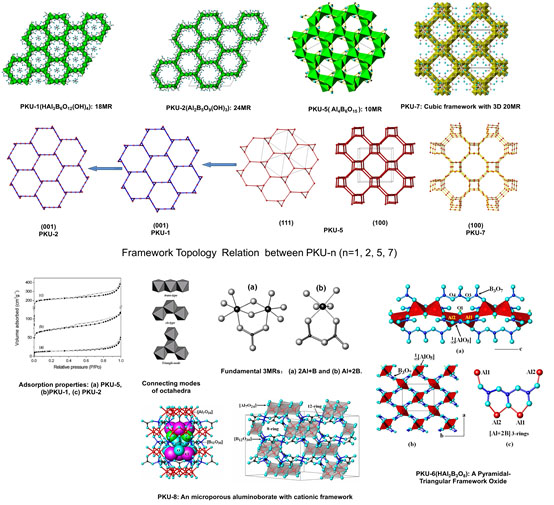
1. Aluminoborates with octahedral backbones: PKU-n (n=1-8) Construction of porous framework by octahedra provides a way of accommodating more metal ions that can only be 6-coordinated in developing the porous structures, which may bring new catalytic, electronic and magnetic properties. We have explored a family of novel microporous aluminoborates with octahedral frameworks, named as PKU-n (PKU from PeKing University). The structures of PKU-1, PKU-2,PKU-5,PKU-6 etc. have been solved by X-ray powder diffraction data. The study on the structural principles for constructing octahedral porous frameworks, and the realization of these compounds demonstrated that edge-sharing octahedra could lead to stable microporous frameworks of new topologies in a large scale. |
 |
|
2.Germanates: PKU-9, PKU-12 and more PKU-ns
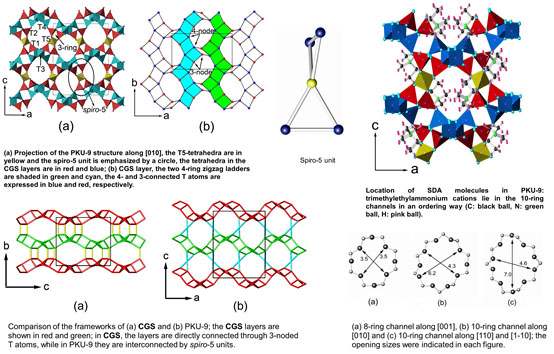
The synthesis of zeolites with novel framework topology has been of interests to academic and industrial communities. In the synthetic effort, we started from the design and syntheses of new tetraalkylammonium cations, and employed them as the structure directing agents in the hydrothermal systems containing silica, germania, boric acid, aluminum hydroxide and etc. Several new zeolitic compounds were carried out and their structures were solved by X-ray diffraction data in combination with electron diffraction. PKU-9 is an aluminogermanate with a new three-dimensional zeolite framework that was designated as PUN by the Structural Committee of International Zeolite Association. The framework is composed of CGS-layers and spiro-5 units, forming three-dimensional intersecting 10- and 8-ring channels with a low framework density, 12.6T/1000Å3. PKU-9 is the first example of porous aluminogermanates that contains spiro-5 unit, which provids an alternative view of using known zeolite layers to design and synthesize topologically new zeolites, and also exemplifies that the existence of 3-ring is useful to low framework density zeolites. |
 |